
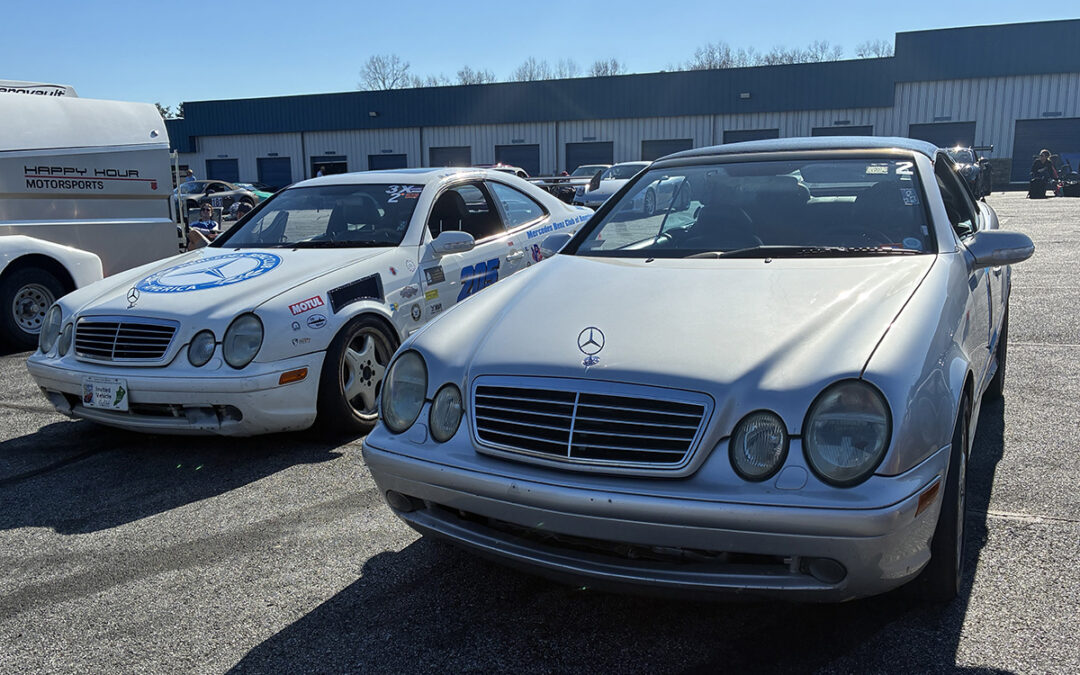
The car on the right had the high ATF level. Cheryl shifted to the car on the left and didn’t want to give it back.
by Gary Edwards, Technical Advisor
Cheryl was having fun driving the 2002 CLK55 at Atlanta Motorsports Park, at least until the car started smoking while exiting the turns. I thought we had a transmission fluid leak, and when checking the Automatic Transmission Fluid (ATF) level, I thought it looked low and added more. I watched closely as she did a few more laps and still saw smoke. Looking closely at the transmission, it looked like the ATF was coming out of the vent, which only makes sense if it’s overfilled.
This car has a 722.6 five-speed automatic transmission, which was used in a wide range of Mercedes vehicles from the late 1990s through the mid to late 2000s. It’s a good, reliable transmission and it’s used in many models including the W210, W208, W203, W220, late R129s, late W140s and others. I had experienced some problems with inconsistent fluid level measurements before and I must be the only one who has had trouble with getting consistent level measurements with these transmissions, as I haven’t seen much in the forums about this.
These cars do not come with dipsticks, though they do have dipstick tubes. You must buy the dipstick tool, which is generic for all cars with 722.6 transmissions. The tool is longer than the dipstick tube and is not designed to stay in the tube, It is also NOT designed to bottom out in the transmission pan, The tool is made with a set of “ears” at the top of the measuring area at the bottom end of the dipstick. These “ears” are designed to be restrained at the bottom of the dipstick tube, suspending the measuring portion of the dipstick so that it doesn’t bottom out. If the dipstick tube or these “ears” are worn, the dipstick can be pushed through allowing it to stick too far into the fluid as it bottoms out in the pan. I think it’s also possible for the dipstick to hang up in the tube, so it doesn’t extend far enough into the fluid. I have seen this occur intermittently such that one reading will show good level and the next will either way too high or way too low. This makes it hard to get the level correct.
To deal with this long term, try this. The next time you have the transmission pan off the car, insert the dipstick into the tube allowing the “ears” to nestle in the bottom of the dipstick tube as intended, and mark the dipstick tool at the top of the tube with paint or a zip tie so that you know the correct insertion depth. In any case, marking the tool at the level of the tube when it’s reading correctly will help you get consistent readings. Note though that this marking will only be correct for that specific car/engine combination, as the length of the dipstick tube varies due to chassis differences.
Just to get back to the basics, we’ll go through the procedure for checking transmission fluid level. Start the engine and run it for a couple of minutes; enough time for the transmission to fill the torque converter with ATF. With your foot on the brake, shift slowly through all gears, several times, pausing long enough to allow it to shift into each gear. Break the seal on the dipstick tube cap and pull the cap off. Leaving it in Park with the engine running, check the level using the dipstick. Cleanliness is of utmost importance here. I usually take about three readings of level and I’m expecting to see the same levels for each. Fluid is added through the dipstick tube; a large assortment of funnels is handy for this, and depending on the car, a tube to extend the funnel may also be necessary.
The dipstick has level marks for 25 degrees C and 80 degrees C – ATF expands greatly as it heats up so the level goes up a lot with temperature. A STAR scanner will show you transmission temperature on some (most?) models, though I find using an infrared pyrometer to measure the transmission pan temperature to be easiest. Note though that the Workshop Information System (WIS) tells you to “Check and pour in transmission oil when cold (approx. 25 C)”. The WIS only has you check fluid level when hot “if shifting problems occur” and this section contains a note “Precise checking is only possible at a transmission oil temperature >80 C” which I think is based on there only being 25 deg and 80 degree marks on the dipstick.
If you have the level too high, the fluid can foam and the foaming will drive fluid out the vent on the top centerline of the transmission. Since most of these cars have exhaust lines running beside the transmission, if ATF is coming out of the vent, it will likely get on the hot exhaust and cause smoking. If the fluid level is significantly low, the transmission may feel like it’s slipping. The WIS provides this warning “Insufficient and excessive quantities of oil can result in malfunctions and transmission damage”.
In summary, I find it easy to get the ATF level wrong in these transmissions. To avoid this, take multiple readings, and mark your dipstick to show you when it’s properly inserted. The home hobbyist can certainly get this right, but it takes patience and perseverance – it’s definitely worth doing yourself but you need the right dipstick tool.