
by Gary Edwards, MBCA Peachtree Technical Advisor
I was quite surprised when I saw 140-chassis Self Leveling System (rear) struts for $225 for a pair on eBay. Since I have two 140 coupes with clunks from the rear suspension, I thought these were worth a try. They arrived quickly and I was pleasantly surprised that they included the upper mounting bushings as well. Installation was delayed, however, by the need to get the transmission out of limp mode (see a few of my other articles). This delay subsequently became important.
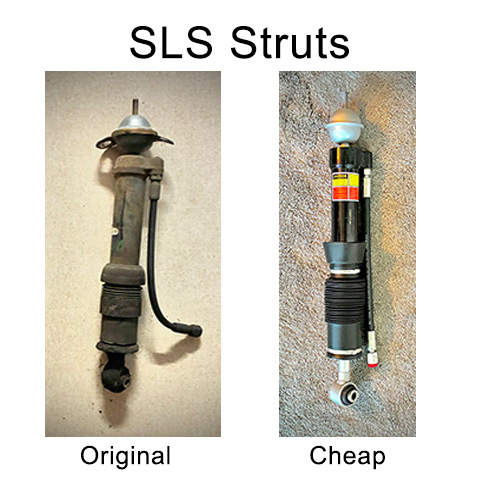
When I finally was able to do the installation, I noted a couple of differences between the original units and these cheap replacements. First, the alignment of the upper tube and the lower tube didn’t match their orientation as installed in the car. This would normally be simply resolved by rotating the lower tube portion to match what’s needed. However, as on the original item, there is a rubber bellows covering the area where the upper and lower portions meet. Unlike the original, however, the lower portion of the boot was secured with an Oetiker clamp (a crush clamp that cannot be loosened without cutting). I cut the clamp, rotated the strut to the correct orientation and used a hose clamp to replace it. This was minor.
The original strut has a metal piece above the upper mount that is oblong, and this oblong shape matches the shape of the car’s recess that the top of the strut fits into. It functions to maintain the orientation of the upper portion of the strut as the upper retaining nut is tightened. The cheap replacement lacks this oblong metal piece, so that it is not possible to restrain its rotation when its being tightened. This is further exacerbated by the lack of any way to hold the threaded upper stud from turning. This threaded stud is inserted through the hole at the top of the recess in the chassis and a nut is used to secure it in place. In typical Mercedes fashion, the original strut has a feature that allows you to restrain the threaded stud from turning by inserting an Allen wrench into a female Allen fitting in the top of the stud. The cheap struts lacked this feature so that the stud tended to turn when tightening the nut, at least until the strut rotated to contact the chassis.
Now for some notes on replacing these struts before jumping to the ending. First, since these struts are controlling the rear ride height, you must jack up the rear of the car to get the rear wheels off the ground to allow removal of these struts. Second, this is a high pressure hydraulic system so be ready for fluid to spray out when you loosen the hydraulic line connection. There is a bleed valve on the level control valve (under the car left side just aft of the sway bar) however I’m comfortable with just slightly loosening the connection and waiting until all the pressure has bled off. You’ll want a container to catch the oil too. The upper mount is accessed in the trunk; the trunks side inner liner needs to come out for access.
On my car (1997 S500 Coupe), upon removal of the old struts it was obvious that the clunking had been coming from the lower mount that bolts into the lower control arm. This is NOT a bushing, it’s a spherical metal joint and both sides had A LOT of play. The original struts were not leaking. I subsequently located a source for this lower joint, though the replacement involves cutting some welds on the lower portion of the strut so the original joint can be removed and the replacement can be installed. This would be a viable repair and would cost slightly less than these cheap struts if you are doing the labor yourself – and if your original struts aren’t leaking.
Once these cheap struts were installed, I added hydraulic oil to the reservoir and monitored the level closely as I idled the car, replenishing the fluid as necessary. It is not necessary to bleed the system of air. It is said to be self-bleeding, which I doubt; I think it’s more likely that at the high pressures this system uses, any trapped air is compressed into such a small volume that it does not impact system operation. Unlike a braking system where trapped air gives you a spongy pedal or a pedal that drops to the floor, this system will just raise the pressure to its setpoint and maintain it there.
After a short test drive, I drove the car to Atlanta and back. By the time I got home, something didn’t feel right. When I pulled into the garage, I noted that the right rear was low and fluid was dripping behind that wheel. The reservoir was nearly empty, and oil was everywhere around the right rear. I was hoping that it was just the lower hydraulic line connection needing tightening but that was not the case. Since I haven’t yet removed the strut, I haven’t located the leak, but the only potential leakage points are the upper end of the hydraulic hose, its connection into the strut, or the strut seal itself.
Due to my installation delay, I had gotten outside the 30 day return window cited on eBay. The text included a two year warrantee, so I communicated via eBay messaging with the seller. They wanted pictures; I sent pictures. Then they wanted pictures again, so I re-sent the pictures. Then they wanted me to send them the failed part, which would have made the car immobile. I told them several times that I’d send them the failed part once I had replaced it with a new one. After about a month of back and forth with the seller always being quite pleasant though sounding a bit forgetful, I finally received a box containing two new struts. I haven’t installed the new one yet and thus I don’t have the final post-mortem on the strut, so it’s hard to say whether this was all worth it or not.
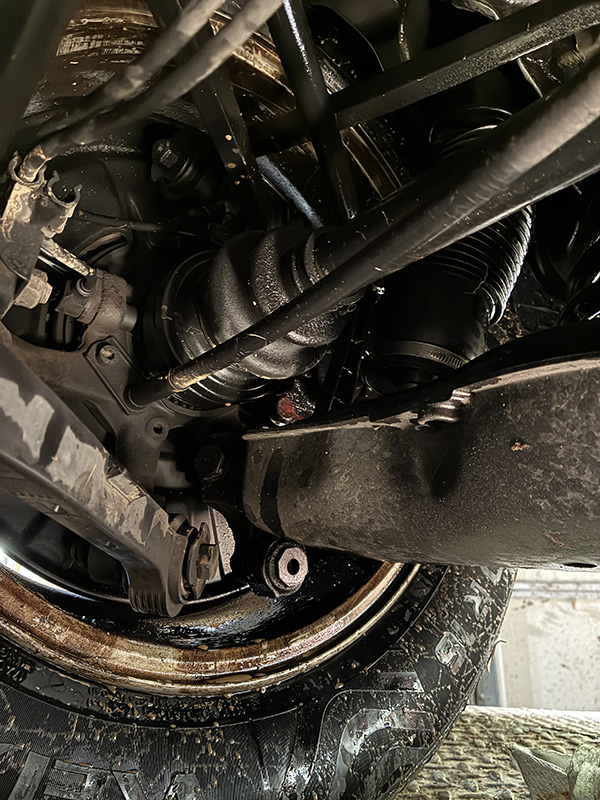
Oil everywhere, strut is visible in the upper right
$225 for a pair of rear SLS struts is shockingly attractive especially since the upper bushings are included (priced one of these struts lately, plus the upper bushings?). The early failure and the delay in replacement make me think twice about whether this makes sense, however. Given that I had clunking but no leakage, I’m beginning to think that replacing just the lower mount would have been preferable.
Addendum – Since I wrote the above, I have finally changed the leaking strut. When I removed it, I found that the hydraulic line connection to the strut was loose. This is near the top of the strut which is surrounded by the “strut tower”, so it is invisible when the strut is installed. The line had come installed by the manufacturer, so I had not thought to check its tightness. I certainly checked this on the replacement strut.
I think that the leaking strut will probably be serviceable once it’s cleaned up and the leaking fitting is tightened. This leads me to conclude that taking a chance on these inexpensive struts is probably worth the money.