
by Gary Edwards, Technical Advisor
Replacing the idler arm bushing is mostly straightforward job with some potential complications. This applies to many Mercedes; any of the Mercedes that do not have rack and pinion steering have an idler arm and its bushings are a wear item. Mercedes started using rack and pinion steering with the 210 chassis in 1995, so just about all older Mercedes have an idler arm, up to the 124, 129, 140, and 202/208.
With the recirculating ball steering on most older Mercedes, the steering gear box is on the driver’s side of the car and provides its inputs to the steering linkage with a link called a pitman arm. This is connected to the left tie rod directly (for a left-hand drive car), but it’s a long way from the right tie rod, so an arm called the drag link connects to the pitman arm and goes horizontally across the car. To ensure that the linkage is symmetrical and that the input to the right tie rod is the same as the input to the left tie rod, an arm kinematically identical to the pitman arm is positioned on the passenger side of the car. This arm is called the idler arm, and it is hinged to the chassis with a large bolt which has upper and lower bushings. When these bushings get worn, there is play in the steering linkage.
The symptom is play in right front wheel that isn’t apparent on the left side. When you jack up the right front wheel, place your hands at the 9 and 3 o’clock positions and check for play. If there is any motion, check that the steering wheel isn’t turning (a car with no play in the steering might feel like it has play if the steering wheel is moving). If there is motion, the wheel bearing should be adjusted properly to take out any contribution from the wheel bearing. Note that diagnosis of too loosely adjusted wheel bearings is typically done by checking for motion in both the side to side (3 and 9 o’clock) position and the up and down (12 and 6 o’clock) positions. In my experience, however, I have found wheel bearings that were out of adjustment and only showed motion in one axis instead of both. Once the wheel bearings have been eliminated as the source of the play, have a helper move the wheel while you look at the steering linkage to see where the “lost motion” or play exists (warning, the car needs to be on a lift or on jackstands for safety when doing this). Extreme cases can result in a shimmy in the steering.
An idler arm bushing kit normally includes the bolt, the nut and upper and lower bushings. The car needs to be on a lift or on jackstands; a lift is preferable since the nut can sometimes be very tight and it’s helpful to have good access to get it loose. Many of the cars have a heat shield or shields that must be removed for access.
The nut can be very tight and difficult to remove, especially since access in some chassis isn’t that good. I just did this on a C140, and access to the nut is restricted since it points towards the front subframe without enough clearance to get a socket on it. I could get a 22mm box end wrench on it, but I couldn’t budge it. I wanted to use a cheater, but none of my cheaters were large enough to fit over the open end of the 22mm wrench. I could have turned the wrench around and used the open end on the nut – the box end would have fitted into the cheaters – however since it was so tight I thought that the open end would just round off the nut. After a lot of penetrating oil and a trip to the auto parts store where I bought another 22mm wrench, I hacksawed the box end off the wrench so I could fit the cheater over it. Using about a 2-foot cheater and a lot of force, I was finally able to loosen the nut. Hint: When you cut a wrench so you can use a cheater, don’t just cut the open end off, cut it a few inches in from the open end so the piece you cut off is still usable. This left me with an open end 22mm wrench only about 2 inches long that I later used on the upper end of the bolt to hold it while I was removing the nut.
The factory Workshop Manual (WSM) typically tells you to disconnect the tie rod and the drag link from the idler arm, but I’ve found that you don’t need to do that for most Mercedes. Every time you remove these, you risk damaging their rubber boot, so it’s best not to touch these unless absolutely necessary. One the nut is off; you must remove the bolt. On some cars there is plenty of clearance above and it comes right out. In my experience, most Mercedes have something in the way, often an exhaust line. For the C140 I was working on this time, it was a heat shield around the starter, which was easily removed. On some Mercedes, the upper bushing can be pushed out of its bore with the bolt still in it (with the nut removed of course) and this allows enough of an angle on the bolt to get it around the obstruction. The arrangement of the C140 does not allow this and it came out easily with the heat shield removed. One other trick I’ve used to get a bolt around an exhaust line is to partially file just one flat of the bolt barely enough to slide by the exhaust. Some have removed all the exhaust hangers to help move it out of the way, and others have lifted the right side of the engine to improve the clearance.
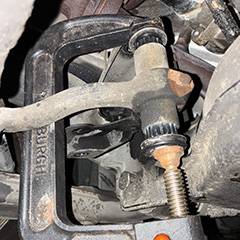
With the bolt out, you can usually tap out the bushings. I’ll typically lubricate the new bushings with glycerin, though some also put them in the freezer beforehand. They can be difficult to seat; you can use the nut and bolt to fully draw them in, and on the C140 I had good enough access to use a large C-clamp to seat them. After that you just insert the bolt and tighten the nut to the specified torque. Note that on the C140 I could not get a torque wrench on it, so I used the PDT method (Pretty Damn Tight).
I did remove the steering damper to improve access, and I had ordered a new one – I usually reason that if I’m going to remove a steering damper, I might as well just put on a new one, these are wear items like the shock absorbers and are generally reasonably priced.
I was pleased to see that almost all the steering play was removed with replacement of the idler arm bushings on this C140. I also replaced the right tie rod and the drag link, which removed the rest of the play I had detected. Changing the tire rod and the track rod required resetting the front toe, which would not be required if only replacing the idler arm bushings.
In conclusion, if you maintain any older Mercedes that does not have rack and pinion steering, sooner or later you’re going to have to replace idler arm bushings. Though there are some potential trouble areas, it’s well within the capability of the do it yourselfer.