

CV Joint Agony
I had just done a lot of work on the CLK55 Coupe and was changing brake fluid on both 2002 CLK55s on the Monday before an HPDE event that weekend. I hadn’t taken a close look at the CLK55 cabriolet yet. When removing the cabriolet’s wheels for the brake bleeding, I saw the telltale radial splatter of grease around the left inner Constant Velocity (CV) joint. Oh no! So much for my plans for the week!
Fortunately, the last time I did this work, I bought two CV joints since I was a little concerned about the availability of these parts. I had used the Lobro/GKN (OEM) joint but the FEBEST kit with boot was still on my shelf.
This is a bit more challenging on a CLK55 than on some cars since the CV joint must be removed with a puller. To do this I must remove the axle shaft from the car. These are also sometimes referred to as half shafts; they go from the differential to the wheel carrier and have CV joints on both ends. I will refer to them as axle shafts.
The first step is to remove the 30mm 12 point hub nut which is staked onto the hub. I remove the wheel for access to unstake the nut then I replace the wheel minus the center cap. I also douse the nut and surroundings with penetrating oil. The torque is high so the car must be on the ground to remove it, with the transmission in park, the parking brake set and the wheels chocked. I use a deep socket, and place wood wedges around it so it won’t come off the nut as I loosen it with a LONG cheater (six foot pipe).
I then lift that wheel (only), and back the hub nut off to protect the threads on the stub axle. I then tap on it with a hammer using a brass punch to protect the stub axle. This almost always starts it moving, but not today. I moved on and left this for later.
I removed the six bolts holding the inner CV joint to the differential flange. These had torx heads, and it’s important to ensure you are fully on the bolt – you can’t afford to strip these. You can only get to a couple of these at one time. I do this with the car on a four post lift, with a jack positioned to lift the appropriate rear wheel. With the car in neutral, I’ll loosen the bolts I can access, then lift that wheel off the ground so I can turn it allowing me to access the next bolts. I then lower it so the wheel is back in contact with the ground – that way the weight of the car holds the wheel and allows you to loosen the bolts. I go through this cycle until all the bolts are loosened.
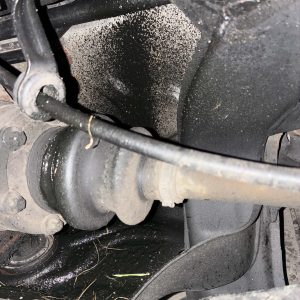
The tell-tale splatter of grease announcing a CV boot failure
Once the bolts are removed, it’s important to support the axle shaft so that the inner CV joint isn’t carrying all its weight. The exhaust is under the left side axle shaft, and I lowered the exhaust for better access (I don’t think the axle shaft can be removed with the exhaust in place). Since it’s a cabriolet, I also had to remove the left side diagonal support strut, which runs under the exhaust. There is also a bracket for the parking brake cable that can be gently bent out of the way for better access to remove the axle shaft.
I have a big puller that I used in futile attempts to remove the axle shaft from the hub, after using a lot of penetrating oil. It wouldn’t budge despite all my extreme efforts. My alternative was to destructively remove it. I could probably get it out with lots of heat, but it would require replacing the wheel bearing and I didn’t have one. I decided to remove the entire rear wheel carrier.
With the typical Mercedes five link rear suspension, this is a significant job, especially since you must disassemble the parking brake assembly (reassembling this is the hardest part). You need a metric spline socket set to loosen the suspension bolts and you also need a good selection of ball joint pullers.
First you must get the brake rotor off. Removing the pads and the caliper gives access to the rotor; it’s not necessary to disconnect the brake line, but you must support the caliper, so it doesn’t put stress on the rubber brake line. The rotor is ostensibly held on by one allen headed bolt, but you’ll probably find that the rotor is reluctant to come off the hub even with the bolt removed. The parking brake shoes should be adjusted as loose as possible to ensure they aren’t restraining it. The CLK55 has very poor access to do this. You must stick a screwdriver through one of the lug bolt holes to do this adjustment – there is no adjustment slot in the backing plate, and the adjustment hole in the hub is inaccessible with the rotor in place. Note that the Factory Workshop Manual (WSM) has you loosen the cable tensioner in the interior rear seat area; I did not do this. Even with the brake shoes retracted fully, the rotor is likely to be rusted to the hub. I had to use a puller to remove it though it did not take a lot of force to break it loose.
With the rotor off the parking brakes are exposed. You must wrestle the retraction springs off so you can remove the shoes; this is complicated by the fact that the hub is still in place, partially blocking access. You then must remove the pin restraining the cable in its mechanism, which is quite fiddly. Once all the parking brakes components are removed, you need to unbolt the brake splash shield for access to one of the linkage bolts. You can’t remove it since it won’t fit around the hub, but you can turn it to allow access to the blocked bolt.
With the parking brakes dealt with, you can remove the speed sensor and all the suspension links. You then can remove the wheel carrier along with the axle shaft (a bit unwieldy, but doable by yourself).
At this point I realized that I finally had good access to the inner CV joint, so I didn’t waste any more time trying to get the shaft out of the hub. I just put the driveshaft in my vise, with the wheel carrier attached.
This allowed me to remove the CV joint (pull the retaining ring, separate the inner and outer thin metal shield pieces, and pull it off). Clean the shaft extensively and tap the new CV on, after installing the new boot and its metal shield. If it’s not fully on, you won’t be able to get the retraining clip seated. Fully grease the CV joint and put any remaining grease in the boot. Be careful to ensure the boot clamps don’t interfere with the bolt holes; it’s hard enough to get the bolts in with the boot on, you don’t need the clamp in the way too. This was a FEBEST brand CV joint, and though a complete kit, the bolts were too long and would have hit the differential case, so I reused the original bolts. I would have preferred the original Lobro (now GKN) CV joints, but they are getting hard to find and I didn’t have one on the shelf. Note that the GKN joint does not include the boot or any of the other pieces.
Reassembly is the reverse of removal. Support the weight of the axle shaft so the outer CV joint isn’t carrying it. I used wood blocks to support the wheel carrier in nearly the correct position so I could start the first bolt on the lower control arm. Get all the linkages hooked up but don’t tighten the bolts yet.
The WSM tells you that the suspension linkage bolts are supposed to be tightened only with the car’s weight on the suspension. I have typically done this by completely assembling the car then tightening the bolts with the car on the lift sitting on its wheels. This cannot be done for the rear linkages since some of the bolts are inaccessible when fully assembled. I did this by placing a jack (with appropriate pad) under the lower control arm and picking up the full weight of that end of the car, then tightening the bolts. This won’t matter for the links that have ball joints, but the ones that have rubber bushings need to be tightened in their normal position or the ride height will be affected and the bushing’s life will be shortened. There were a couple of bolts that I could not get a torque wrench on and these I just used the PDT method (pretty damn tight).
Once you get all the suspension links on and tightened, the real challenge begins. Getting the securing pin through the end of the parking brake cable is very fiddly, and then the big challenge is parking brake assembly. You mount the shoes, install the upper retraction spring, ensure the adjusting mechanism is fully loose (adjusted as short as possible) and work that in between the top of the shoes, and then spend the next hour trying to install the lower retraction spring.
After trying for a while I stopped and watched a YOUTUBE video, but that person had a helper – I didn’t. The spring is very stiff and the presence of the hub in front of it makes access tight. I finally succeeded by fixing the hub into position with the adjusting hole adjacent to the spring and inserting a screwdriver through the hole to lever on the coils of the spring. This allowed me to use my other hand with a set of needle nose pliers to guide the end of the spring into its hole. I fixed the hub into position using two lug bolts and a long extension whose motion was limited by the “floor” of the lift.
I tightened the CV to differential flange bolts after I had the wheel back on, using the same strategy as when I removed them. I torque these in a crosswise pattern and mark each with a paint marker to verify it’s torqued and to let me easily see if it has subsequently started to loosen up. I did have a little trouble getting the inner end of the axle shaft into position on the flange; it seemed like it was too long, but I found that if I worked it in from the upper rear (instead of the more obvious front lower approach) it fit in easier.
The hub nut is a high torque nut and needs to be tightened with the cars weight on the ground, the car in park and the wheels chocked. I do not have a torque wrench that large, but my cheater is marked with one foot intervals, and I divide my body weight into the required torque and that tells me how far out the cheater I need to be pushing down with all my weight. Once it’s at the required torque I jack up that corner, remove the wheel and stake the bolt.
The WSM says to check alignment after replacing the wheel carrier; I didn’t do this. I was short on time, I was reinstalling the same wheel carrier, and I didn’t touch either of the adjusting bolts. The toe and camber adjustments for this car are on the inboard ends of the links, and I only removed the outboard bolts.
This car did well on the following track weekend, however when looking over the other CLK55 after that weekend, I found the same radial splatter of grease around its left inner CV joint – here we go again! I’m not looking forward to changing another inner CV joint!